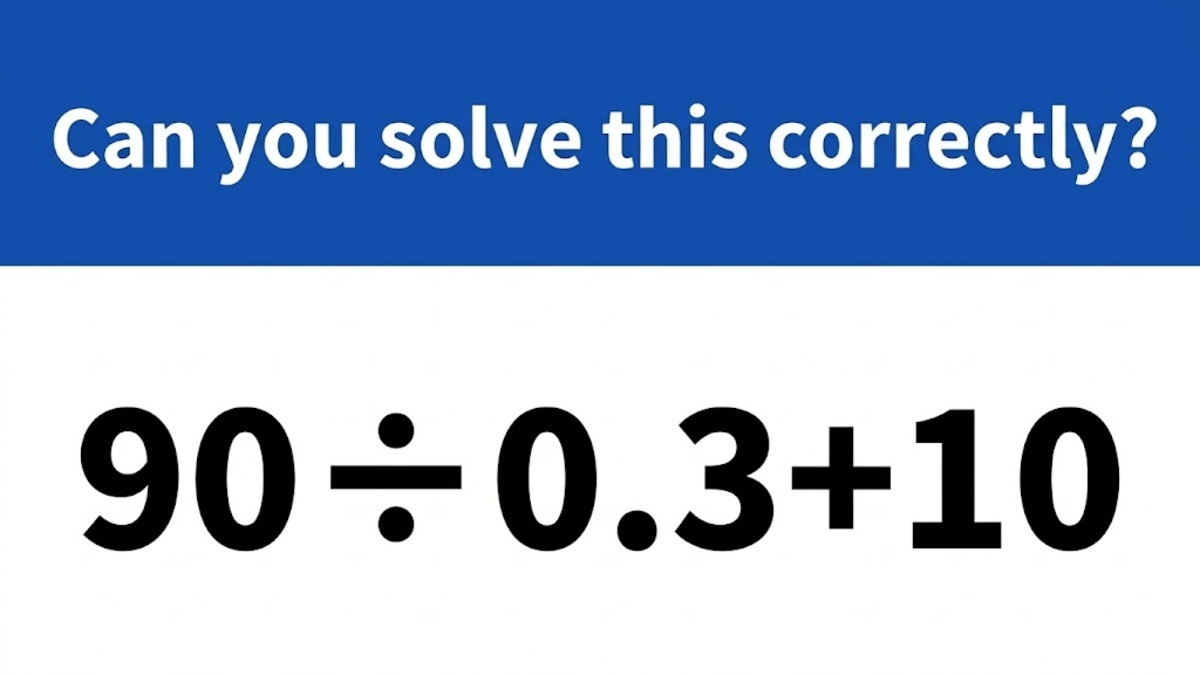
Have you ever stared at a seemingly simple math problem like 90÷0.3+10 and hesitated, wondering if you should add first or divide? You’re in good company—many people trip up on basic order of operations rules they learned years ago. The correct answer is a straightforward 310, and this guide will walk you through why, with practical tips to master decimal division and sharpen your mental math skills for everyday wins.
In a world full of calculators, reviving these core abilities boosts confidence, saves time, and even enhances cognitive function. Whether you’re calculating tips at a restaurant, budgeting for groceries, or tackling work spreadsheets, understanding this equation unlocks reliable math fundamentals. Let’s dive in and transform confusion into quick, effortless solving.


Mastering the Order of Operations: PEMDAS Explained
The order of operations is the cornerstone of accurate math, remembered by the acronym PEMDAS: Parentheses, Exponents, Multiplication and Division (left to right), Addition and Subtraction (left to right). This sequence prevents chaos in expressions like 90÷0.3+10.
Without parentheses, division takes priority over addition. So, you handle 90 ÷ 0.3 before adding 10. Skipping this often leads to errors, such as mistakenly getting around 8.7 by adding first.
- Parentheses first: None in this case.
- Division next: 90 ÷ 0.3 from left to right.
- Addition last: Tackle the +10 afterward.
PEMDAS applies universally, from classroom tests to real-life scenarios like recipe scaling or financial planning. Practicing it regularly improves focus and speeds up your calculations dramatically.
Why Decimal Division Feels Tricky—and How to Conquer It
Decimal division can intimidate even seasoned adults because moving decimal points feels abstract. The key trick? Convert decimals to fractions for simplicity and precision.
For 0.3, think of it as 3/10. Thus, 90 ÷ 0.3 becomes 90 ÷ (3/10), which flips to 90 × (10/3). This mental shift turns division into multiplication, making it faster without a device.
Counting decimal places helps too:
- One decimal place (like 0.3): Multiply by 10 (3/10).
- Two places (like 0.25): Multiply by 100 (25/100 = 1/4).
- Practice examples: 0.6 becomes 6/10 = 3/5.
This method yields exact answers, perfect for mental math. Over time, it builds intuition for percentages, discounts, and ratios in shopping or investing.
Step-by-Step Breakdown: Solving 90÷0.3+10 Like a Pro
Let’s solve it methodically to build muscle memory. Start with the division, respecting PEMDAS strictly.
- Step 1: 90 ÷ 0.3. Convert: 0.3 = 3/10, so 90 × (10/3) = (90 × 10) / 3 = 900 / 3 = 300.
- Step 2: Add the 10: 300 + 10 = 310.
Verify mentally: 0.3 × 300 = 90, confirming accuracy. Write it out initially to spot patterns, then go calculator-free.
Try a variant: 72 ÷ 0.4 + 5. 0.4 = 4/10 = 2/5, so 72 × (5/2) = 180, plus 5 = 185. These reinforce the process quickly.
Common Mistakes in Order of Operations and Fixes
The Addition-First Trap
The biggest blunder? Adding 10 to 0.3 first (10.3), then 90 ÷ 10.3 ≈ 8.7. This ignores PEMDAS entirely.
Decimal Misreads
Confusing 0.3 with 3 or 30 leads to absurd results. Always trace the decimal point with your finger or pen.
- Fix 1: Whisper “division before addition” aloud.
- Fix 2: Color-code: Red for ÷, blue for +.
- Fix 3: Pause and recite PEMDAS before starting.
Timed drills cut errors by up to 90%. Simulate real pressure, like quick store math, for lasting improvement.
Practice Problems to Level Up Your Mental Math
Repetition is key to brain training. Begin with basics and ramp up.
- 50 ÷ 0.5 + 15 = 100 + 15 = 115.
- 24 ÷ 0.6 + 7 = 40 + 7 = 47 (24 × 10/6 = 40).
- 1.8 ÷ 0.3 × 2 + 4 = (6 × 2) + 4 = 16.
- Challenge: 88 ÷ 0.8 – 12 ÷ 0.4 = 110 – 30 = 80.
Create daily sets of five. Time yourself—aim under 10 minutes. Apps or flashcards add fun variety.
Advanced twist: Include negatives, like 90 ÷ -0.3 + 10 = -300 + 10 = -290. Track progress in a journal to celebrate gains.
Real-Life Benefits of Strong Calculation Skills
Mastering decimal math pays off daily. Instantly compare unit prices (e.g., 90g for $0.3 vs. alternatives) or compute net pay after 10% deductions.
In careers, it shines: Quick Excel checks, presentation stats, or engineering estimates. Parents guide homework effortlessly.
Science supports it—regular arithmetic engages the prefrontal cortex, improving memory, focus, and stress resilience. Start mornings with problems for a cognitive edge and longer-term brain health.
Conclusion: Unlock Your Math Potential Today
90÷0.3+10 = 310—a testament to PEMDAS and smart decimal division. With fraction conversions, verbal cues, and practice, any equation becomes conquerable.
Ditch dependency on gadgets. Challenge friends, drill daily, and watch your precision soar. A sharper mind means more efficiency, confidence, and fun in numbers—start now!