In a world bombarded by endless noise and distractions, Stephen Hawking‘s words cut through like a cosmic ray: “Las personas tranquilas y silenciosas son las que tienen las mentes más fuertes y ruidosas.” This theoretical physics icon didn’t just reshape our understanding of the universe—he defied a grim ALS diagnosis at age 21, living over 50 more years to leave an indelible mark on cosmology. His journey proves that true brilliance often brews in inner silence, far from the spotlight.
We’ll dive into his remarkable path, from academic roots to personal triumphs, groundbreaking theories, and a cultural legacy that still inspires millions. In our hyper-connected age, Hawking’s insight highlights the power of introspection to unlock mental potential.


Early Academic Foundations of a Prodigy
Stephen William Hawking entered the world on January 8, 1942, in Oxford amid World War II chaos. From childhood, his fascination with scientific puzzles shone brightly, leading him to University College, Oxford, where he earned top honors in physics.
His sharp analytical skills stunned professors and peers alike. He thrived on challenging assumptions, laying the groundwork for revolutionary ideas.
At Trinity Hall, Cambridge, Hawking pursued graduate studies in general relativity and cosmology. His fresh, bold perspective quickly marked him as a rising star in theoretical physics.
Key Milestones in His University Journey
Hawking’s early career buzzed with promise. Mentors foresaw his potential to redefine modern science through innovative approaches.
- Oxford studies: Excelled in advanced physics and mathematics.
- Cambridge postgraduate work: Pioneered theoretical physics research.
- Early publications: Disruptive analyses of singularities in the Big Bang.
By 1979, he ascended to the prestigious Lucasian Professor of Mathematics at Cambridge—a role once held by Isaac Newton. He held it until 2009, relentlessly probing the universe’s deepest secrets.
Defying ALS: Resilience Beyond Limits
At 21, Hawking faced a shattering ALS (amyotrophic lateral sclerosis) diagnosis. This progressive neurodegenerative disease attacks motor neurons, leading to paralysis, immobility, and speech loss. Doctors predicted just years to live, yet he reached 76 with an unimpaired, prolific mind.
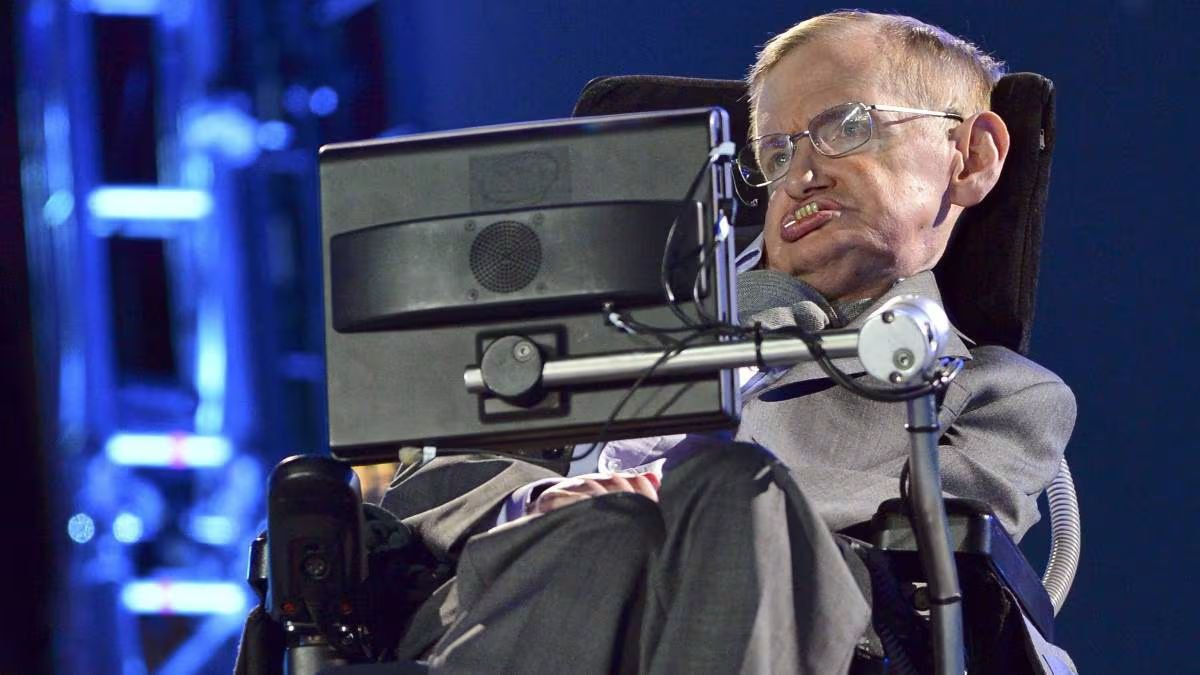
As ALS advanced, his intellect sharpened. Though his body failed, he adapted with a cheek-muscle-controlled speech synthesizer, composing at 15 words per minute and producing scientific masterpieces.
Family support anchored him—married twice, father to three, he balanced career and home life despite pneumonias and setbacks. ALS enforced profound introspection, where physical silence amplified his mental creativity.
How Adversity Fueled Innovation
This unyielding spirit advanced ALS treatments and assistive tech, aiding thousands today. Hawking embodied his quote: the noisiest minds dwell in the quietest forms, showing physical barriers can’t contain infinite potential.
- Adapted communication tools revolutionized accessibility.
- Inspired global research into neurodegenerative diseases.
- Proved mental strength transcends bodily constraints.
Groundbreaking Contributions to Cosmology
Hawking’s imprint on theoretical physics is monumental. In 1974, he introduced Hawking radiation, positing that black holes emit particles and evaporate—bridging quantum mechanics and general relativity in a paradigm shift.
Collaborating with Roger Penrose, he mathematically proved spacetime singularities, essential to the Big Bang and stellar collapses. These insights propelled string theory and quantum gravity forward.
His theorems guide today’s global experiments. Labs simulate Hawking radiation quantumly, unlocking fresh universe insights.
Core Scientific Achievements
- Hawking radiation: Key prediction of black hole evaporation.
- Singularities: Confirmed in critical cosmic events.
- Theoretical fusion: Linked quantum and relativistic realms.
Awards like the Copley Medal and Presidential Medal of Freedom crowned him. Elected to the Royal Society in 1974, he stood as a science titan.
Making Science Accessible: Bestselling Books
Hawking excelled at demystifying complex ideas for the masses. His 1988 blockbuster, A Brief History of Time: From the Big Bang to Black Holes, sold millions in 40 languages, unraveling the universe’s origins accessibly.
He simplified the Big Bang and black holes for non-experts, sparking global scientific curiosity and careers in physics.
- A Brief History of Time: Cosmology’s gateway for beginners.
- Black Holes and Baby Universes: Delves into quantum multiverses.
- The Universe in a Nutshell: Poetic, visual cosmic tour.
- Brief Answers to the Big Questions: Concise wisdom for wide audiences.
These works educated and ignited generations to question reality and push knowledge boundaries.
Cultural Icon and Timeless Legacy
Hawking transcended labs into pop culture, voicing himself on The Simpsons and Star Trek with his iconic synthesizer. The 2014 film The Theory of Everything captured his humanity, earning an Oscar.
He warned of unchecked AI, climate change, and championed space colonization. His foundation drives ALS progress and inclusive tech, transforming lives.
In our social media frenzy, his quote calls for unplugging to reconnect inwardly. Embrace silence for breakthrough ideas; hurdles are illusions.
Stephen Hawking illuminated the cosmos, outlived ALS by 55 years, revolutionized cosmology, and popularized science. His mantra endures: outer calm harbors inner genius storms.
Let his story ignite scientists, dreamers, and quiet thinkers. Silence the external din to awaken your inner universe—endless possibilities await.